
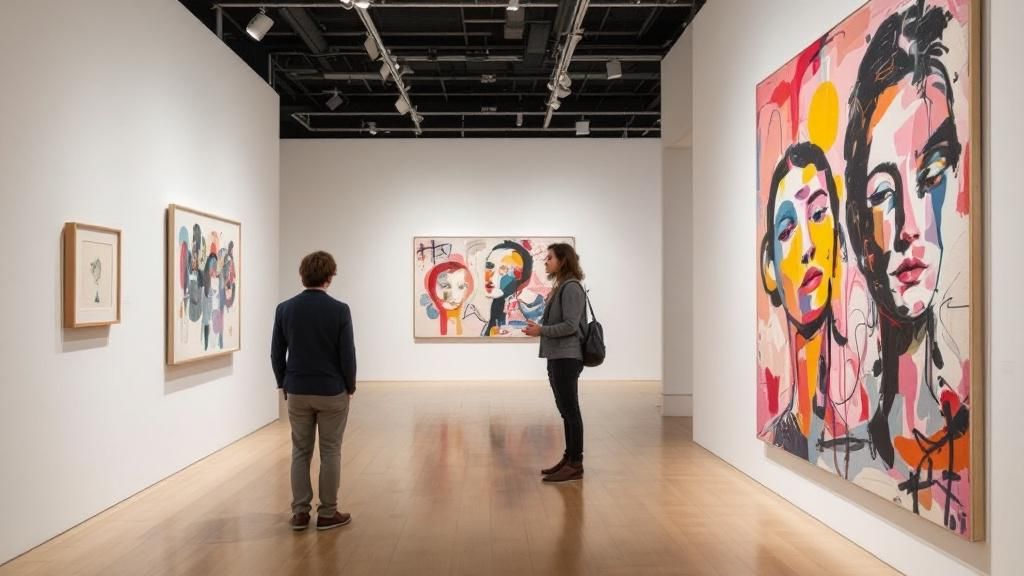
The Turner Prize has long served as a gauge of modern artistic expression, and this year’s display proves no exception. By featuring works that consciously challenge the distinctions separating abstraction and representation, the curators have crafted a thought-provoking challenge to viewers’ preconceptions about what art can communicate. This article investigates how the chosen creators deploy non-traditional approaches and theoretical structures to interrogate our grasp of artistic vocabulary, ultimately asking if the traditional distinctions between abstract and representational art hold relevance in the contemporary art world.
Reconsidering Abstract Boundaries
The Turner Prize display this year deliberately dismantles established categories that have long governed artistic discourse. By displaying artworks that seamlessly oscillate between abstraction and figuration, the curators prompt viewers to reconsider their assumptions about how we create visual meaning. The exhibition reveals that contemporary artists increasingly reject binary classifications, instead embracing hybrid approaches that interrogate how we perceive and interpret visual information. This curatorial method prompts visitors to reflect more carefully with the artist’s intention and aesthetic experience.
These boundary-transcending works demonstrate a wider movement within current art practice towards conceptual fluidity and experiential ambiguity. Rather than adhering to rigid stylistic categories, the presented artists deploy techniques that deliberately destabilise spectator preconceptions. The presentation shows that abstraction and representation are not entirely separate territories but rather positions on a continuous spectrum. This reconceptualisation prompts deeper contemplation about how meaning emerges through the relationship between artwork, spectator interpretation, and interpretive context, profoundly altering critical dialogue.
The Development of Visual Communication
Visual language has experienced profound evolution during the twentieth and twenty-first centuries, notably as artists confronted photography’s impact to representational painting. Modernist movements initially established abstraction as a revolutionary departure from mimetic traditions, establishing ostensibly impassable conceptual divides. However, contemporary practitioners increasingly recognise these past distinctions as artificial constraints. The exhibition illustrates how visual language develops naturally, integrating varied sources and methodologies that transcend traditional categorical boundaries, reflecting our increasingly complex visual culture.
Contemporary artists now combine elements from abstraction, representation, and theoretical structures with unprecedented sophistication. This combined methodology recognises that artistic expression operates through multivalent channels simultaneously. The Turner Prize exhibition showcases how artists manipulate colour, form, composition, and symbolic reference to create layered meanings that resist singular interpretation. This evolution demonstrates that creative vocabulary has matured beyond ideological rigidity, favouring instead a sophisticated lexicon capable of expressing the intricacies inherent in contemporary experience and perception.
Present-Day Interpretations
Modern artists explore abstraction with substantially different philosophical frameworks than their earlier counterparts, drawing from postmodern theory, digital culture, and global artistic traditions. Rather than pursuing pure abstraction as an conceptual destination, modern artists treat abstract elements as means of expression within wider strategic frameworks. The display features works wherein geometric structures, gestural marks, and colour relationships coexist with representational elements and textual elements. This multi-faceted approach reflects current perspectives that visual communication arises from multifaceted exchanges rather than through single stylistic positions or aesthetic principles.
The chosen artists display remarkable facility in engaging with diverse aesthetic modes at once, producing works that reward sustained contemplation and interpretive flexibility. Their work indicates that contemporary art increasingly functions as a dialogue between artist, artwork, and viewer, rather than as a one-way pronouncement. By incorporating varied aesthetic vocabularies, these artists recognise that the creation of meaning in contemporary culture requires careful engagement of competing aesthetic systems. The exhibition ultimately proposes that modern critical understanding requires viewers relinquish rigid categorical thinking, embracing instead the productive ambiguity that characterises sophisticated artistic practice.
Public Response and Public Discourse
The exhibition has generated substantial discussion amongst art critics and academics, with responses ranging from wholehearted support to careful reservations. Classical advocates have queried whether the blurring of abstract and representational boundaries constitutes authentic advancement or simply aesthetic confusion. In contrast, contemporary perspectives have praised the curators for questioning ossified categorisations that cease to represent current artistic approaches. This spectrum of perspectives underscores the exhibition’s significance as a impetus for serious dialogue within cultural institutions and the broader public.
Public participation in the exhibition has surpassed projections, attracting diverse audiences beyond the conventional gallery-going demographic. Social media commentary indicates that visitors are seriously wrestling with the pieces’ underlying concepts, offering readings and debating alternative interpretations. Museums have reported increased footfall and extended viewing times, suggesting that audiences are deeply interested in understanding creative intent. This organic engagement shows that contemporary art can speak compellingly with the general public when presented with sufficient contextual support and cognitive accessibility.
The exhibition’s impact extends further than immediate critical evaluation, potentially shaping future curatorial approaches and artistic orientation across institutional structures. New artists have cited the show as a watershed moment, validating experimental practices that synthesise abstract and representational work. Learning institutions are beginning incorporating the exhibition’s ideas in their teaching programmes, acknowledging its educational value. As dialogue evolves to evolve, the Turner Prize exhibition seems set to hold a prominent role in modern art history, transforming dialogue concerning artistic classification and artistic possibility.
